No Good, Very Bad Weeds
Hairy galinsoga (Galinsoga quadriradiata) is a big problem in the community garden. It is a prolific, seed-producing summer annual with opposite, egg-shaped to triangular leaves with coarsely toothed margins, sharp tips and densely hairy upper leaf surfaces. Numerous small flower heads are formed in terminal and axillary clusters. Each head has four to five white, three-toothed ray flowers and centers with numerous yellow disk flowers. The seed is enclosed in a single-seeded, brown to black, wedge-shaped, wind-disseminated fruit.

Purple Deadnettle (Lamium purpureum L.) is another big problem in the garden. It is a prolific, seed-producing winter annual. Leaves are opposite, triangular to ovate, and are covered in soft hairs. Young leaves at the apex are usually tinted purple while lower mature leaves are green. Leaves are deeply veined and have scalloped margins. Petioles are short. Unbranched stems are square and largely glabrous. The lower portion of the stem is often devoid of leaves. Whorls of flowers occur above the leaf axils, and a terminal whorl of flowers occurs at the top of each stem. Flowers are tubular and are purple to pink in color. The lower lip is divided into 2 rounded lobes. Each flower produces 4 nutlet seeds.
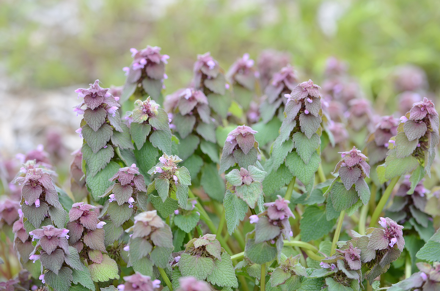
Please pull these weeds when you see them and DO NOT COMPOST THEM!
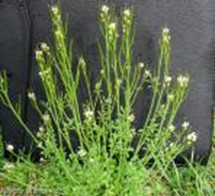
Hairy Bittercress (Cardamine hirsute) is a winter annual broadleaf weed and is a member of the Brassicaceae or mustard family. Other common names include Bittercress, Flick Weed, Hoary Bittercress, Lamb’s Cress, Land Cress, Shot Weed, and Springcress.
The plant is native to Europe and Asia. It has been introduced in most of all other continents including North America, South America, Africa, and Australia. Hairy Bittercress is typically one of the first weeds to appear in spring.It is capable of growing year-round when suitable environmental conditions are met. The seeds germinate in the fall or winter. Typically they are dormant in cold weather, and they resume their growth in the spring and produce more seeds. It has a 12-week lifecycle. They can quickly invade poorly mulched gardens. It is commonly found in sunny, damp, or disturbed soil.
The stems are erect, branched, and 3-10 inches tall. The root is fibrous and shallow. In the spring, clusters of tiny white flowers emerge that have cross-shaped petals on the ends of the stem. The small green leaves are mostly on the lower portion of the stem and form a flat rosette. Tiny hairs are on the upper and lower surfaces of the leaves. The fruits appear between March and May. They are siliquas or long narrow seed pods rods standing upright around the flower. When they mature, seeds are dispersed up to several feet from the plant. Each plant may produce 600 to 1000 seeds. The weed quickly becomes prolific in the garden and is best controlled by prevention. Hand weeding and adequate mulching of garden beds are helpful. Hairy Bittercress flowers and leaves are edible and valuable nutrients. Although the name suggests that they may taste bitter, they actually have a mild peppery taste. A few sprigs may be added to salads, salsas, and pesto. The flowers are tougher to chew.
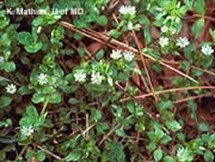
Common chickweed (Stellaria media) produces shallow, fibrous root systems and long, branching stems that grow prostrate along the soil surface and root at nodes. This species produces flowers, fruits, and seeds from spring to early fall. Seeds can germinate during spring, summer, and fall. Common chickweed produces one or two generations per year and can sometimes act as a short-lived perennial. Common chickweed stems grow close to the ground then turn slightly upright, giving rise to leaves and flowers.
Common chickweed produces up to 30,400 seeds per plant, with an average of 25,000 seed per plant. The seed is persistent because it takes 3 years for the seed bank to be reduced by 50%. Remove the plant before it goes to seed.
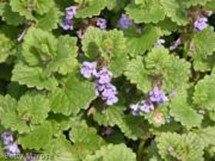
Creeping Charlie (Glechoma hederacea) is an herbaceous perennial plant that spreads by seed and by creeping stems (called stolons) that grow along the ground. It is a very prolific member of the Mint family. Creeping Charlie was introduced into North America from Europe by early settlers who thought it would be a good groundcover for shade. A variegated form of the plant is sometimes used in hanging baskets. Creeping Charlie is also known as ground ivy, gill-on-the-ground, and creeping Jenny.
In areas where creeping Charlie has become established, remove all of the plant by hand.
Common Purslane (Portulaca oleracea) is a fast-growing herbaceous annual with succulent leaves and stems. Even the oblong cotyledons (seed leaves) are succulent. The multiple smooth, reddish stems originating from a single taproot are mostly prostrate, forming a mat covering up to 3 feet in diameter. Depending on the amount of moisture available, the plant may be quite low-growing or more erect up to 16″ tall. Pull it before it goes to seed.
Purslane is considered quite nutritious because it is unusually high in omega-3 fatty acids (found mostly in fish and flax seeds) and contains significant amounts of vitamins A and C, as well as calcium, iron, magnesium and potassium and antioxidants.
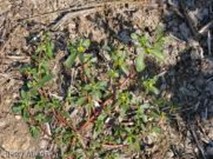
Insects We Don’t Want!
In order to reduce the spread of certain problematic insects, here are three insect pests that community gardeners should be able to identify and should be gotten rid of. If these insects are detected early and removed, invasion into surrounding gardens and crop damage can be reduced. If you spot one of these insect pests either in your garden or your neighbor’s, please post it on the group email so other members become aware of the problem.
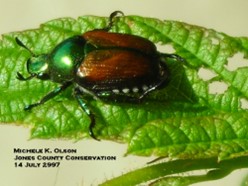
Japanese Beetle
- ½ inch in length and metallic blue-green with tan wings
- Eggs laid in soil in June develop into grubs which overwinter
- Adults emerge from soil the following June and begin feeding
- Look for skeletonized leaves
- Adults feed on asparagus, corn and basil
Treatment
- Hand pick and drop into bucket of soapy water (2TB/Gallon)
- Place drop cloth under plant and shake. Drown in soapy water.
- If problem is severe pest crew will set up pheromone traps.
Colorado Potato Beetle
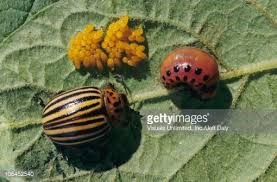
- Adults are orange-yellow, 3/8” long with black stripes
- Beetles overwinter in the soil as adults
- Look for orange-yellow eggs on the underside of leaf
- Young larvae are brick red with black heads
- Older larvae are pink to salmon colored with black heads
- All larvae have two rows of dark spots on each side of their bodies.
- Feeds on potato, eggplant, tomato, pepper
Treatment
- Plant early maturing potato (less than 80 days) to avoid summer predation by adults
- Crush eggs on underside of leaf starting in May, before population gets established. One adult can lay 300-800 eggs in small batches. Check leaves frequently!
- Handpick larvae and adults and drop into container of soapy water. Larvae can be picked and crushed.
- Vacuum larvae and adults with a Dustbuster!
Squash Bugs
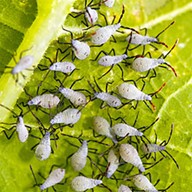
- Adults are over ½”, brown with a flat back. Nymphs are pale grey
- Adults overwinter in debris in the fall and mate in spring
- Look for bronze eggs on underside of leaf and crush
- Nymphs and adults have sucking mouthparts. A toxin is injected into the leaf and sap is sucked out. The leaves will wilt, dry up, turn black, crisp, and brittle. Smaller plants will die.
Treatment and prevention
- Remove debris from garden in fall
- Crush eggs on underside of leaf starting in May, before population gets established.
- Place board on ground in evening and in morning crush nymphs and adults that have sheltered there, or drown in soapy water.
- Avoid deep, cool mulches like straw or hay

Soil Testing
The Michigan State University Soil & Plant Nutrient Lab offers an easy-peasy, mail-in garden soil test. Results provide levels of Phosphorus (P), Potassium (K), Magnesium (Mg), Calcium (Ca), Cation Exchange Capacity (CEC), soil type, soil pH, lime index and the level of organic matter in the sample. The test results offer personalized recommendations for garden soil improvements, if needed.
https://homesoiltest.msu.edu/get-started
Sources of Seeds and Plants
Merkel Gardens in Chelsea, Michigan sells bedding plants of all varieties, including flowers, vegetables, and succulents. Their produce includes everything from basic vegetables to many exotic Asian vegetables. More “basic” vegetables include green beans, tomatoes, eggplant, kale, pickling cucumbers, potatoes, melons, carrots, pumpkins, squash, broccoli, collards, and Swiss Chard. Asian vegetables include bittermelon, bokchoi, edible gourd (cucuzzi), and wintermelon.
Nature & Nurture Seeds in Dexter, Michigan is an organic, farm-based seed company offering heirloom (open-pollinated) vegetable, flower and herb seeds. Their seeds are certified organic, non-hybrid, non-GMO, sustainably-grown and adapted to the Midwest.
https://natureandnurtureseeds.com/
Johnny’s Selected Seeds, a 100% employee-owned company in Maine, offers a wide variety of organic, non-GMO seeds.
Baker Creek Heirloom Seeds believes that gardeners and communities have the right to save their own seed, and in so doing preserve seed diversity and food security in an age of corporate agriculture and patented, hybridized or genetically modified seeds. All the seeds that they sell can be saved, shared and traded, and they encourage people to save their own seed.
Gardening Techniques
Biodynamics
Biodynamics is a holistic, ecological and ethical approach to gardening, food and nutrition.
Biointensive Gardening
Ecology Action teaches people worldwide to better feed themselves while building and preserving the soil and conserving resources. Their work focuses on growing in a bio-intensive manner and their website includes excellent information on organic gardening.
The eight principles of the Grow Biointensive Method are:
- Deep Soil Preparation
- Composting
- Intensive Planting
- Companion Planting
- Carbon Farming
- Calorie Farming
- Open-Pollinated Seeds
- Whole System Method
Small Tools Inventory 2022
4 spades, 2 square shovels (small), 1 square shovel (large), 1 trenching shovel, 2 mulching forks, 2 garden forks, 2 regular hoes, 2 triangular hoes, 1 stirrup hoe, 1 three prong cultivator, 1 mattock, 3 garden rakes, 2 sprayers (large), 4 sprayers (32oz), 5 watering cans, 6 trowels, 2 “hand plow” cultivators (orange handle), 3 pronged cultivators, 1 hand hoe (small), 1 curved weeder, 1 pruner, 1 grass trimmer, 1 bow saw, 1 lopper, 1 rubber mallet, 1 coarse toothed sickle (idiot stick), 1 set measuring spoons, 2 scrub brushes
Companion Planting
Companion planting guidelines will show you which vegetables and flowers support or inhibit the growth of other plants and/or which pests they deter.
Basil
Plant near: most garden crops
Keep away from: rue
Comments: improves the flavor and growth of garden crops, especially tomatoes and lettuce. Repels mosquitoes.
Plant near: beets, cabbage, carrots, catnip, cauliflower, corn, cucumbers, marigolds, potatoes, savory, strawberries
Keep away from: fennel, garlic, leeks, onions, shallots
Comments: potatoes and marigolds repel Mexican bean beetles. Catnip repels flea beetles.
Beans, Pole
Plant near: corn, marigolds, potatoes, radishes
Keep away from: beets, garlic, kohlrabi, leeks, onions, shallots
Comments: same as for bush beans.
Plant near: broccoli, brussels sprouts, bush beans, cabbage, cauliflower, chard, kohlrabi, onions
Keep away from: charlock, field mustard, pole beans
Borage
Plant near: squash, strawberries, tomatoes
Keep away from:
Comments: repels tomato worms. Improves flavor and growth of companions.
Plant near: beets, buckwheat, calendula, carrots, chamomile, dill, hyssop, marigolds, mints, nasturtiums, onions, rosemary, sage, thyme, wormwood.
Keep away from: strawberries
Comments: marigolds repel cabbage moths. Nasturtiums repel aphids.
Plant near: broccoli, brussels sprouts, celery, chard, spinach, tomatoes.
Keep away from: strawberries
Comments: tomatoes and celery repel cabbage worms.
Plant near: corn
Plant near: cabbage, chives, early potatoes, leeks, lettuce, onions, peas, radishes, rosemary, sage, salsify, wormwood.
Comments: onions, leeks, and wormwood repel carrot flies
Chives
Plant near: apples, berries, carrots, grapes, peas, roses, tomatoes.
Comments: Improves flavor and growth of companions. Deters aphids and Japanese beetles.
Plant near: beans, cucumbers, early potatoes, melons, peas, pumpkins, soybeans, squash.
Comments: soybeans deter chinch bugs.
Plant near: beans, cabbage, corn, early potatoes, radishes, sunflowers.
Keep away from: late potatoes
Comments: Radishes deter cucumber beetles. Cucumbers encourage blight in late potatoes.
Dill
Plant near: broccoli, brussels sprouts, cabbage, cauliflower, cucumber, lettuce, onions
Keep away from: carrots
Comments: Improves flavor and growth of cabbage family plants.
Plant near: green beans, peppers, potatoes, tomatoes
Comments: green beans deter Colorado potato beetles.
Plant near: cabbage, cane fruits, fruit trees, roses, tomatoes
Keep away from: peas, beans
Comments: deters Japanese beetles and aphids. A garlic oil spray deters onion flies, aphids, and ermine moths. A garlic tea helps repel late potato blight.
Plant near: aromatic herbs, buckwheat, cabbage family, marigolds, nasturtiums
Keep away from: pole beans, strawberries
Plant near: cabbage/cauliflower companions (except tomatoes)
Keep away from: fennel, pole beans, tomatoes
Comments: kohlrabi stunts tomatoes
Plant near: beets, carrots, parsnips, radishes, strawberries
Keep away from: cabbage family
Comments: lettuce tenderizes summer radishes.
Marigolds
Plant near: all garden crops
Comments: stimulates vegetable growth and deters bean beetles, aphids, potato bugs, squash bugs, nematodes, and maggots.
Marjoram
Plant near: all garden crops
Comments: stimulates vegetable growth.
Mustard
Plant near: alfalfa cover crops, fruit trees, grapes, legumes
Comments: stimulates growth of companion plants.
Nasturtiums
Plant near: apples, beans, cabbage family, greenhouse crops, potatoes, pumpkins, radishes, squash
Comments: repels aphids, potato bugs, squash bugs, striped pumpkin beetles, and Mexican bean beetles and destroys white flies in greenhouses.
Plant near: beets, cabbage family, carrots, chamomile, lettuce, parsnips
Keep away from: beans, peas
Comments: deters most pests, especially maggots.
Oregano
Plant near: all garden crops
Comments: deters many insect pests.
Parsley
Plant near: corn, roses, tomatoes
Plant near: onions, radishes, wormwood
Comments: onions and wormwood help keep root maggots from parsnips.
Plant near: beans, carrots, corn, cucumbers, early potatoes, radishes, turnips
Keep away from: garlic leeks, onions, shallots
Plant near: basil, carrots, eggplant, onions, parsley, tomatoes
Keep away from: fennel, kohlrabi
Plant near: basil, beans, cabbage family, corn, eggplant, flax, hemp, marigolds, peas, squash
Keep away from: apples, birch, cherries, cucumbers, pumpkins, raspberries, sunflowers, tomatoes, walnuts
Comments: hemp deters phytophthora infestans. Basil deters potato beetles. Marigolds (dug into crop soil) deter nematodes.
Plant near: chervil, cucumbers, lettuce, melons, peas, nasturtiums, root crops
Keep away from: hyssop
Comments: radishes deter cucumber beetles. Chervil makes radishes hot. Lettuce helps make radishes tender. Nasturtiums improve radishes’ flavor.
Rosemary
Plant near: beans, cabbage, carrots
Comments: repels bean beetles, cabbage moths, and carrot flies.
Sage
Plant near: cabbage family, carrots, tomatoes
Keep away from: cucumbers
Comments: deters cabbage moths and carrot flies. Invigorates tomato plants.
Soybeans
Plant near: corn, potatoes
Comments: chokes weeds and enriches soil.
Plant near: celery, cauliflower, eggplant, strawberries
Plant near: borage, bush beans, lettuce, pyrethrum, spinach
Keep away from: cabbage family
Plant near: cucumbers
Keep away from: potatoes
Comments: can provide a trellis and shelter for shade-loving cucumbers.
Plant near: bush beans, kohlrabi, onions
Keep away from: pole beans
Tarragon
Plant near: all garden crops
Comments: improves vegetables’ flavor and growth.
Thyme
Plant near: all garden crops
Comments: deters cabbage moths.
Plant near: asparagus, basil, cabbage family, carrots, gooseberries, mustard, parsley, onions, rosemary, sage, stinging nettles
Keep away from: fennel, kohlrabi, potatoes, walnuts
Plant near: peas
Keep away from: knotweed, mustard
Comments: mustard and knotweed inhibit the growth of turnips and rutabagas.
Source: Mother Earth News
 Chelsea Community Garden